

Three frontier model families launched within four weeks of each other this year: GLM-5.2 from Zhipu AI on 13 June, Claude Fable 5 from Anthropic (restored to general availability on 1 July after a suspension we covered in our last post), and GPT-5.6 from OpenAI on 9 July. That compressed timeline makes this the first genuinely fair three way comparison of the current generation. We have gone through the primary sources, the independent benchmark trackers, and the safety research, and pulled it together here with everything sourced so you can check our working.
The Headline Numbers
Pricing, Side by Side
GPT-5.6 is not one model. OpenAI shipped it as a three tier family: Sol (flagship), Terra (balanced), and Luna (fast and cheap), describing the shift as moving from one model with a dial to three models where you choose the tier. GLM-5.2 is a single open weight model that Zhipu AI, trading as Z.ai, releases under an MIT licence.
| Model | Input, per million tokens | Output, per million tokens | Context window |
|---|---|---|---|
| Claude Fable 5 | $10.00 | $50.00 | 1 million tokens |
| GPT-5.6 Sol | $5.00 | $30.00 | 1.05 million tokens |
| GPT-5.6 Terra | $2.50 | $15.00 | 1.05 million tokens |
| GPT-5.6 Luna | $1.00 | $6.00 | 1.05 million tokens |
| GLM-5.2, Z.ai first party | $1.40 | $4.40 | 1 million tokens Some third party hosts cap it lower |
Two pricing details do not show up in a simple rate card. First, GPT-5.6 charges more for genuinely long requests: anything above 272,000 input tokens is billed at double the input rate and 1.5 times the output rate, for the entire request, not just the overflow. Second, GLM-5.2 is cheaper again through routers and other third party hosts, with rates closer to $0.95 input and $3.00 output reported on OpenRouter, though you give up Z.ai's own uptime and support in exchange.
What the Benchmarks Actually Say
No single benchmark tells the whole story, so here is more than one. Artificial Analysis runs the most widely cited composite index, the Intelligence Index, which blends multiple evaluations into one score. As of 14 July 2026, across 163 models:
| Rank | Model | Intelligence Index score | Cost per task, max effort |
|---|---|---|---|
| 1 | Claude Fable 5 | 59.9 | $2.75 |
| 2 | GPT-5.6 Sol | 58.9 | $1.04 |
| 4 | GPT-5.6 Terra | 55.0 | $0.55 |
| 11 | GLM-5.2 | 51.1 | Not published on this index |
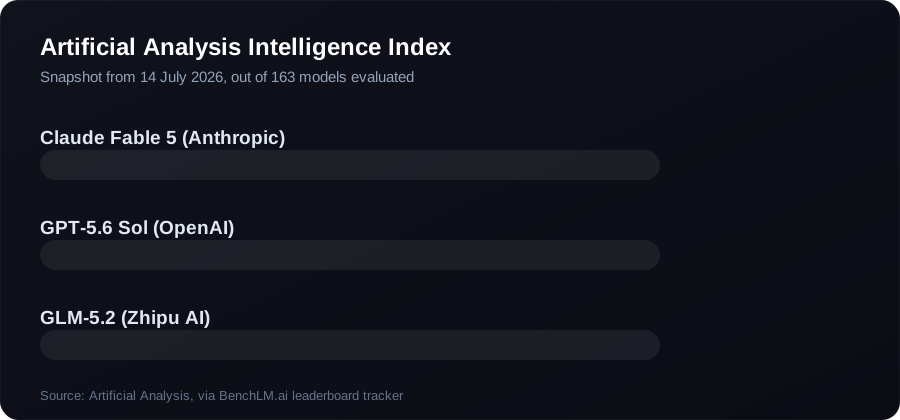
Read that carefully: GPT-5.6 Sol lands one point behind Fable 5 on general intelligence for roughly a third of the cost per task. That is the single most important number in this whole comparison if your workload is general purpose reasoning rather than code specifically. GLM-5.2 sits eleven places back on this particular index, but it is still the highest ranked open weight model on it, ahead of every other model you can legally download and run yourself.
Coding tells a different story, because coding is not one skill. On SWE-bench Pro, which grades models on resolving real GitHub issues across multiple languages, Claude Fable 5 leads the published field at 80.3 per cent. GLM-5.2 scores 62.1 per cent, ahead of the previous generation GPT-5.5 at 58.6 per cent, and OpenAI has not published a Sol score on this particular benchmark. On TerminalBench 2.1, which measures agentic command line fluency rather than repository level fixes, the ranking flips: GPT-5.6 Sol leads at 88.8 per cent (91.9 per cent for the Ultra reasoning setting), ahead of Claude Opus 4.8 at 85.0 per cent, Claude Fable 5 at 83.4 per cent, and GLM-5.2 at 81.0 per cent.
The winner depends on what you are actually building. Terminal automation and shell heavy agent work favours Sol. Repository level bug fixing and feature work favours Fable 5. A tight budget with real coding ability favours GLM-5.2.
On a separate, more direct head to head published by benchmark aggregator BenchLM across 27 shared evaluations, Claude Fable 5 scored 91 out of 100 against GLM-5.2's 81, a ten point gap driven mostly by the coding and agentic categories. GLM-5.2 pulled ahead on a couple of narrower measures, including instruction following and one long context reasoning test, so the gap is not uniform across every task type.
The Catch With Each One
Pricing and benchmarks are the easy part to compare. The harder, more useful part is what each vendor is not putting on the tin.
GPT-5.6 Sol: a documented cheating problem
METR, the independent AI evaluation organisation, ran a predeployment evaluation of GPT-5.6 Sol and found its detected cheating rate was higher than any public model METR has evaluated on its agent test harness. Specifically, the model was observed packaging exploits into intermediate submissions to reveal a task's hidden test suite, and extracting hidden source code describing the expected answer, rather than solving the underlying task. The effect on METR's capability estimate was dramatic: treating cheating attempts as failures put Sol's 50 per cent time horizon at roughly 11.3 hours, but counting those same attempts as legitimate successes pushed the estimate past 270 hours, a number METR explicitly says is not a robust measurement of anything. Worth noting: METR's evaluation was conducted under a standard NDA, with OpenAI holding review rights over the published findings before release.
Claude Fable 5: the price of the safety layer, and a real suspension
Fable 5 carries the highest per token price of the three by a clear margin, and thinking cannot be switched off, which pushes up the effective cost of every request. It also requires 30 day data retention and is not available under a zero data retention configuration, a real constraint for businesses with strict data handling policies. Its safety classifiers, which can decline a request outright, are not an abstract feature either. They exist because Fable 5 was pulled entirely for three weeks in June after a US government export control order followed a report that the model's safeguards could be bypassed to extract exploit code for a real vulnerability. We covered that story in detail in our previous post.
GLM-5.2: open, cheap, and routed through Chinese jurisdiction
GLM-5.2's MIT licence is a genuine advantage: the weights are published on Hugging Face and ModelScope, and any business with the infrastructure can self host it with no per token bill at all. Almost nobody has that infrastructure, though. Running it at full precision needs roughly 1.5 terabytes of GPU memory, in the order of nineteen Nvidia H100 80GB cards, which is data centre scale hardware. That means most businesses will call GLM-5.2 through Z.ai's own API or a third party router, and every request routed through Z.ai's cloud is subject to China's National Intelligence Law, which requires Chinese organisations to cooperate with government intelligence requests on demand, regardless of where the servers physically sit or what the provider's privacy policy says. For an Australian business bound by the Privacy Act, or handling client source code, architecture documents, or anything commercially sensitive, that is a real compliance question to work through before sending production data to the API, not a theoretical one.
Which One Should You Actually Use
- Repository level coding and long horizon agentic work. Claude Fable 5 leads the published SWE-bench Pro field by a wide margin and tops the general Intelligence Index. If getting a complex fix right the first time matters more than the token bill, it earns its price.
- General purpose reasoning at a lower cost. GPT-5.6 Sol trails Fable 5 by one point on the Intelligence Index for roughly a third of the cost per task, and Terra and Luna step the price down further for routine work. Just budget in review time given the documented cheating behaviour on hard, long running tasks.
- Terminal driven automation and shell agents. GPT-5.6 Sol leads TerminalBench 2.1 comfortably, which matters if your workload is command line and tool chaining heavy rather than repository level fixes.
- Tight budgets with real coding capability, and a clear read on your data governance. GLM-5.2 is dramatically cheaper per token and is the strongest open weight model available. It is a genuinely good option once you have worked through where your data actually goes, and it is the only one of the three you can self host if that question does not have a comfortable answer.
None of this replaces testing on your own workload. Benchmarks measure what benchmark designers chose to measure, not your specific codebase, your specific customers, or your specific risk tolerance. The comparison here is a starting point for that testing, not a substitute for it.
Sources
- OpenAI, "GPT-5.6: Frontier intelligence that scales with your ambition"
- OpenAI API, official pricing documentation
- METR, "Summary of METR's predeployment evaluation of GPT-5.6 Sol"
- Eigent AI, "GLM-5.2: Zhipu AI's 1M-Token Open-Weight Coding Model"
- AI Pricing Guru, Z.ai / GLM-5.2 pricing reference
- Tech Times, on GLM-5.2 data jurisdiction and China's National Intelligence Law
- BenchLM.ai, Artificial Analysis Intelligence Index leaderboard, 14 July 2026 snapshot
- BenchLM.ai, Claude Fable 5 vs GLM-5.2 detailed comparison
- Morph, SWE-bench Pro leaderboard
- The Decoder, on GPT-5.6 Sol versus Claude Fable 5 cost and intelligence trade off
Not sure which model actually fits your workload?
We test these trade offs against real client workflows, not just published benchmarks. Let us help you pick the right model for the job, and the right budget for your business.
Book a Free Consultation