
There is a pitch doing the rounds right now, and it sounds compelling on paper. Walk into a local business, an HVAC company, a physio clinic, a plumbing outfit, sell them an AI solution, charge $2,000 a month, scale to 20 clients, and you are suddenly earning $500,000 a year. The guru who sells this pitch usually has a course to go with it.
The problem is not that monthly retainers for AI work do not exist. They do. The problem is what that pitch leaves out: the actual work that has to happen before a retainer makes any sense at all.
I added up what a 10-person service business actually pays for AI implementation when it is done properly. The number is not $2,000 a month from day one. It is a deposit, a project, a run-in period, a handover, and then, only if the system is working and the owner wants it, an ongoing retainer. In that order.
Why the Subscription Frame Gets It Backwards
The appeal of the monthly retainer pitch is the same as any SaaS model: recurring revenue, predictable income, scalable client base. And if you are selling a tool or platform, that model makes sense. You built the thing once; clients pay to use it every month.
AI implementation for a small business is not a product. It is a project. There is a real system being scoped, built, tested, adjusted, and handed over. Treating it like a subscription before any of that has happened is either confused thinking or deliberate misdirection, and it leaves the business owner paying for outcomes they have not yet received.
A retainer is for what comes after a working system. It is not payment for building the system in the first place.
When the sequencing is wrong, the relationship is built on shaky ground from the start. The vendor has revenue before they have delivered anything. The client has a monthly charge with no clear deliverable attached. And when the system does not stick, which it often does not when the build phase is rushed or skipped, nobody is quite sure who is responsible.
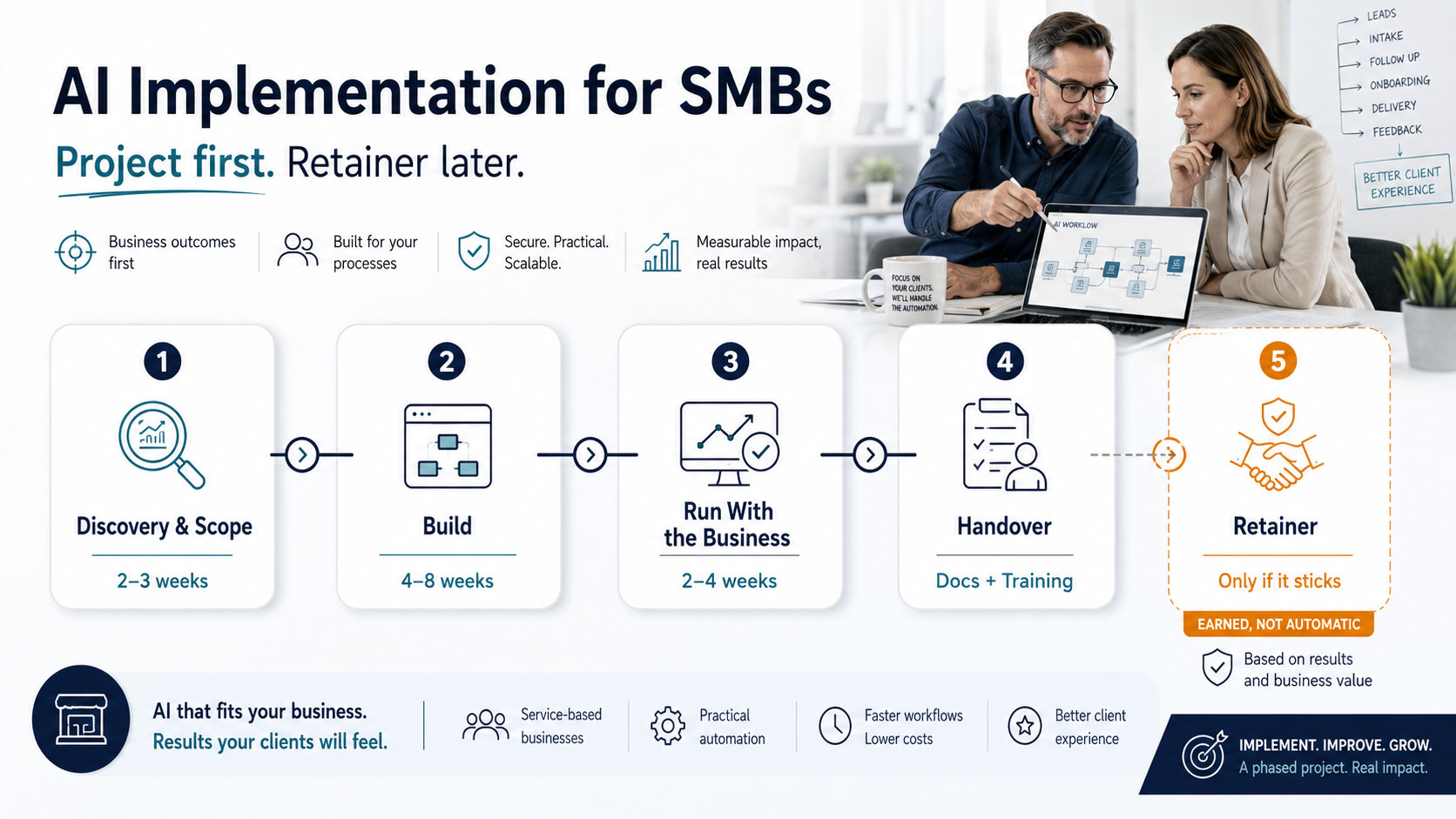
The Five Phases of Real AI Implementation
Here is what a legitimate AI implementation engagement looks like for a 10-person service business getting a meaningful AI system in place for the first time.
Discovery and Scope
Before anyone builds anything, you need to understand what the business actually does, where the time goes, what data exists, and what a successful outcome looks like. This is not a sales call. It is paid work. The output is a scope document the business owner can read, a realistic timeline, and a clear definition of done.
Build
This is where the system gets built. Depending on complexity, that might involve connecting existing tools, building custom workflows, refining prompts, or integrating with industry-specific software. Payment is tied to milestones, not to time on a clock. Progress is visible and the business owner stays in the loop throughout.
Run It With the Business
This is the phase most vendors skip entirely, and it is the one that determines whether the system actually sticks. The implementer works alongside the team, handling edge cases, making adjustments, and correcting gaps between how the system was designed and how the business actually operates. This phase is unglamorous. It is also essential.
Handover
Documentation. Training. A full walkthrough with the owner. The goal is that the business can operate the system without the implementer in the room. If a vendor skips this step, ask why. A system the client cannot manage independently is not a delivered system. It is a dependency.
Retainer
After 30 days of live operation, if the system is running well, the owner has seen the value, and they want ongoing support for changes, monitoring, and improvements, a retainer makes sense. It covers the work that comes after a successful implementation. It is earned, not assumed.
The total timeline before a retainer is even on the table: roughly 10 to 17 weeks. That is the honest version of AI implementation for a service business. Not a standing order from day one.
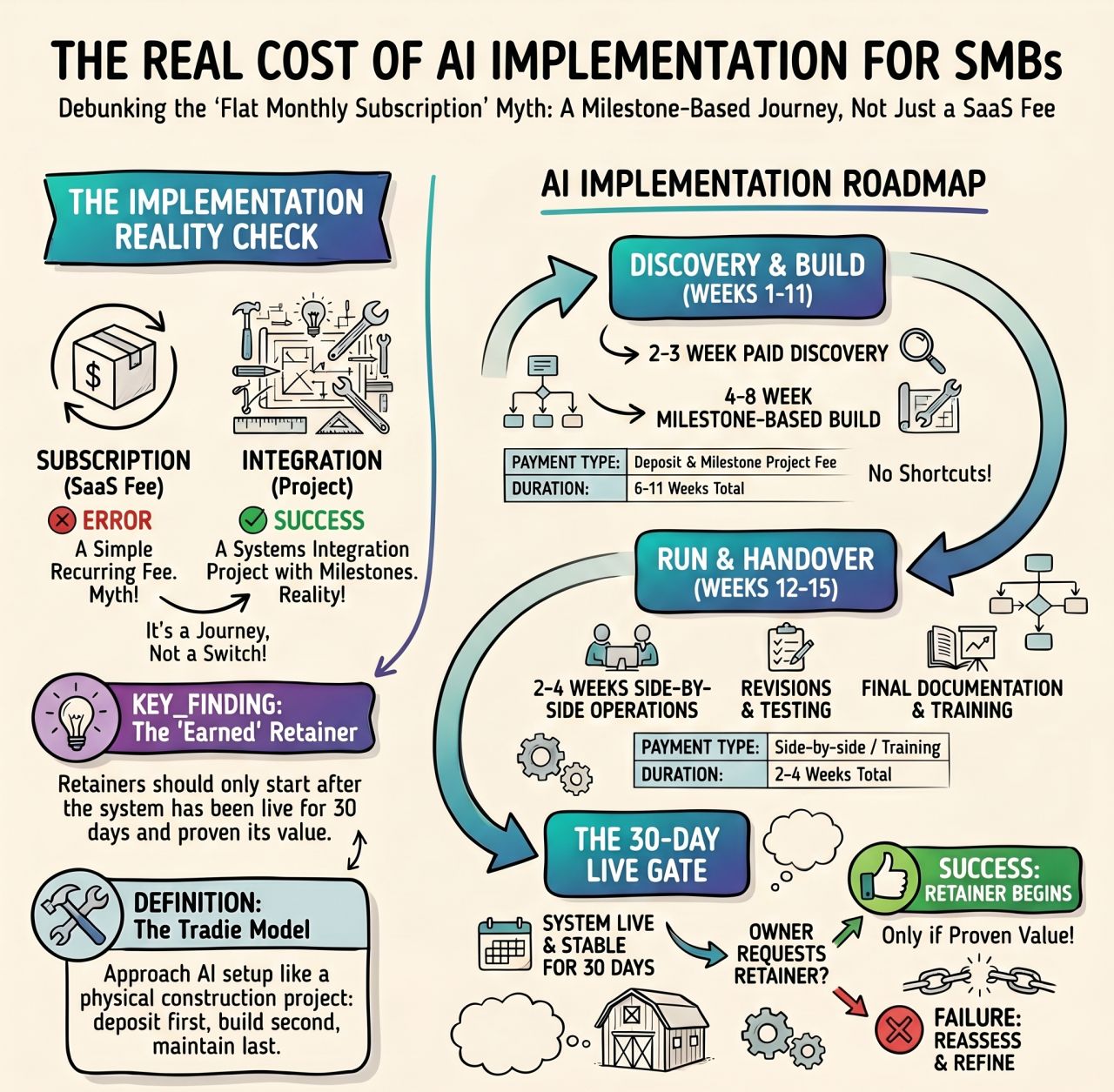
It Looks More Like a Tradie's Project Than a SaaS Fee
When you hire a builder to renovate your kitchen, you expect a deposit, a build phase, a walkthrough, and a final payment when the job is done. You do not expect to pay $500 a month forever just to keep your kitchen. AI implementation works the same way. There is a tangible thing being built, installed, and handed over. The retainer comes after the kitchen is working, not before the first wall comes down.
The work is closer to systems integration than to consulting. A good AI implementer is not showing up each month to give you advice. They are connecting your booking system, your intake forms, your follow-up sequences, and your reporting into something that runs without constant human intervention. That requires a project, not a subscription.
The businesses that get burned by bad AI implementation experiences almost always had this sequencing wrong. They were sold a retainer before a working system existed. The monthly fee funded the build, but without milestones, without a handover, and without any mechanism to hold the vendor accountable for outcomes.
What to Ask Before You Sign Anything
Whether you are evaluating an AI implementer or reviewing a proposal you have already received, these questions will quickly tell you whether you are looking at a legitimate project or a subscription dressed up as one.
The Buyer's Checklist
- Which phase am I paying for right now? If the answer is not "discovery" or "build," push for clarity on what the upfront payment covers.
- What are the milestones, and what happens if they are not met? Milestone-based billing protects you. Flat monthly billing from day one protects the vendor.
- When do you hand over the system, and what does handover include? Documentation and training should be non-negotiable deliverables, not optional extras.
- How long has the system been live before a retainer is proposed? If a retainer is on the table before go-live, you are paying for future work before past work is done.
- What does the retainer actually cover? Changes, monitoring, and improvements are legitimate. Access to the system itself is not, unless it is a platform you are licensing.
- Can you show me a client whose system has been live for six months? Track record matters more than a polished demo.
How Logic8 Approaches This
At Logic8, we work with service-based businesses across Australia to implement AI systems that actually stick. Our process follows exactly this phased model: a paid discovery engagement, a milestone-based build, a side-by-side run-in period with the team, and a documented handover before we discuss anything ongoing.
We do not propose retainers before the system has been live. We earn them.
Our focus is on practical outcomes, not impressive demos. A booking automation that saves a receptionist two hours a day is worth more than a showcase system that never gets properly adopted. We build for the business owner who has to use it every day, not for our own project portfolio.
We also help clients who are mid-engagement with another vendor and not sure whether they are getting a fair deal. Sometimes the best thing we can do is review a proposal and tell you it is a reasonable one. That is a conversation we are always willing to have.
If you are a service business thinking about AI, or wondering whether what you have been quoted reflects what real implementation looks like, we are happy to talk it through. No pitch, no pressure. Just an honest conversation about where you are and what would actually make sense for your business.
Want an honest second opinion on an AI proposal?
We will tell you whether what you have been quoted is realistic, and what a proper implementation engagement should look like for your business.
Book a Free 30-Minute Call