AI models change every few weeks. Are you still paying for the right one?
New models, price cuts and retirements now land every month. Here is why the right model for a job keeps changing, and how staying across it keeps your AI bill down.


In the past three weeks, Anthropic released a new flagship model that is cheaper than the one it replaced, told developers that an older model will stop working at the end of November, and OpenAI announced the retirement of three more of its models. None of that made the evening news. All of it matters if part of your business runs on AI.
The right model for a job in July may not be the right one today. Here is what is changing, what it means for your bill, and how we stay on top of it for our clients.
The ground keeps moving
Since the start of September, from the providers’ own pages:
- A better model got cheaper. On 22 September, Anthropic released Claude Opus 5.5 at $4 per million input tokens and $20 per million output tokens. Anthropic says it costs 40% less to run than Opus 5 and performs at the level of Claude Fable 5.1 on most work.
- A planned price rise was cancelled. When we wrote our Fable 5 pricing guide in July, Claude Sonnet 5 was on introductory pricing due to rise to $3 and $15 on 1 September. Anthropic has since made the $2 and $10 price permanent and the rise will not happen.
- Older models are being switched off. On 30 September, Anthropic told developers that Claude Sonnet 4.5 retires on 30 November 2026. Requests to a model past its retirement date simply fail.
- It isn’t just one provider. On 1 October, OpenAI announced the shutdown of GPT-5.1, GPT-5.4 nano and GPT-5.3 Codex for April 2027, on top of the original GPT-5 and o3 snapshots it is switching off in December. Google’s Gemini “latest” aliases get swapped to a new model with every release, with two weeks’ email notice for breaking changes.
That is one month. It is a normal month.

Prices are falling fast, but only if you move
Epoch AI found that the price of reaching a given level of performance has been falling by anywhere from 9 to 900 times a year depending on the level of performance, though the fastest drops are recent and may not last. a16z put it more simply: for a model of equivalent performance, the cost is falling about 10 times every year. And the Stanford AI Index 2025 found that the cost of running a system at GPT-3.5 level dropped more than 280 fold between November 2022 and October 2024.
Here is the catch. Those savings do not turn up on your bill by themselves. Every Claude model ID is a pinned snapshot, so a system built on a model keeps paying that model’s price. The falls mostly come from newer models doing the same work for less, and you only get them by switching.
Anthropic’s own price list shows how big the gap gets. Claude Opus 4.1, retired in August, cost $15 in and $75 out per million tokens. Opus 5.5 costs $4 in and $20 out. A business that set up on Opus 4.1 and never revisited it was paying three times the price of Opus 4.8, the replacement Anthropic recommended, right up to the day it was switched off. Against today’s Opus 5.5, that is almost four times.
The top spot doesn’t stay put
The leaderboards move just as fast. The Stanford AI Index found that the gap between the top model and the tenth ranked model shrank from 11.9% to 5.4% in a single year, with the top two separated by just 0.7%.
In July, our three way model comparison had Claude Fable 5 at the top of the independent Intelligence Index. When we checked the Artificial Analysis leaderboard on 7 October, the top spot belonged to Claude Opus 5.5, a model that costs less than half as much per token as Fable 5.1. The most expensive model is not automatically the best one, and the best value changes from month to month.
One model for everything is the expensive way
Anthropic’s own advice in its cost guidance is to choose Haiku for simple tasks, Sonnet for most production work, and Opus for the most complex reasoning. Most AI work in a business is routine: sorting emails, pulling details from invoices, tagging support tickets, drafting standard replies. The work that genuinely needs a top model is a much smaller slice.
An illustrative example
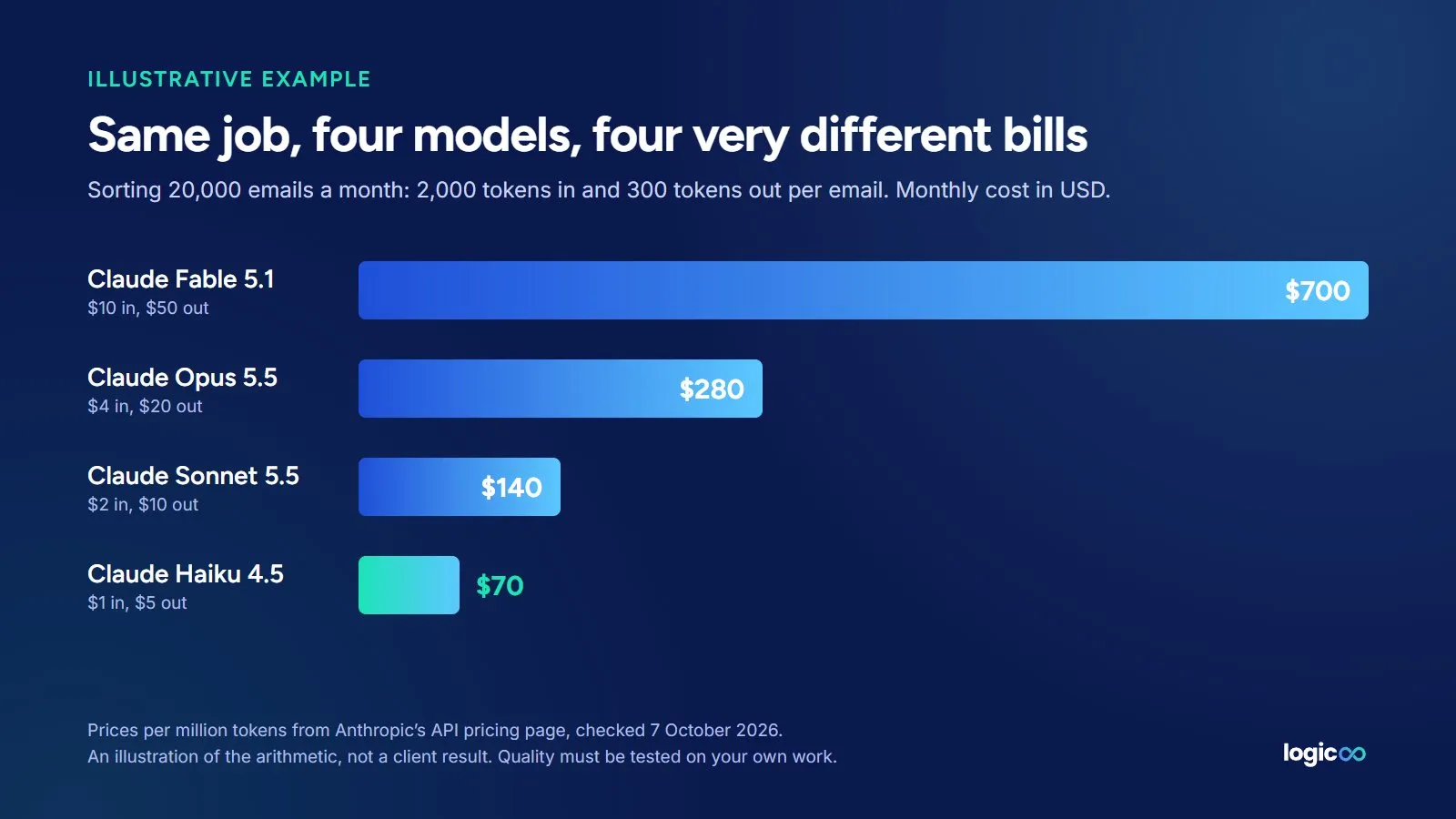
To show the arithmetic, picture a business that has AI sort 20,000 inbound emails a month. Each email takes about 2,000 tokens in and 300 tokens out (a category, a short summary and a suggested next step). That is 40 million input tokens and 6 million output tokens a month. This is an illustration, not a client result. Prices are Anthropic’s published API rates in US dollars, checked on 7 October 2026.
| Model | Input, per million tokens | Output, per million tokens | Monthly bill |
|---|---|---|---|
| Claude Fable 5.1 | $10 | $50 | $700 |
| Claude Opus 5.5 | $4 | $20 | $280 |
| Claude Sonnet 5.5 | $2 | $10 | $140 |
| Claude Haiku 4.5 | $1 | $5 | $70 |
On Opus 5.5, that is 40 × $4 = $160 for input plus 6 × $20 = $120 for output, so $280 a month. On Haiku 4.5, it is 40 × $1 = $40 plus 6 × $5 = $30, so $70 a month. Moving this one task saves $210 a month, or $2,520 a year. If the sorting can wait a few hours, the Batch API halves the price again, bringing Haiku down to $35.
Two honest caveats. First, cheaper only counts if it still does the job, so we test any switch on a sample of your real emails before it goes live. Second, the table probably understates the gap. Anthropic notes that its newer models use a tokenizer that produces about 30% more tokens for the same text, and Opus 5.5 and Fable 5.1 always think before answering, which adds tokens on every request.
There is one more wrinkle. Haiku 4.5, the cheap option in this example, is listed with a retirement date of not sooner than 15 October 2026. Even the model you switch to has its own clock.
Keeping up is a job in itself
Doing this properly means watching three or four providers, re-testing your own tasks whenever something new arrives, checking quality on your data rather than benchmarks, switching safely and watching the bill. It never finishes, and it is exactly the work most owners have no time for.
That is why we offer ongoing retainers once a system has been live for a while. As we wrote in the real cost of putting AI into a small business, a retainer is earned after a working system is in place, not sold before it. Once it is, here is what our team does each month:
- Reviews new releases from the major providers and shortlists anything that could do your tasks better or for less.
- Tests the shortlist on your real work, using a set of examples from your business, so a switch is based on your results and not a leaderboard.
- Switches when it is worth it, with your sign off, and checks the output side by side afterwards.
- Handles retirements early, well inside the notice period, so nothing stops working on a Monday morning.
- Reports the bill task by task, so you can see what each job costs and what changed.
What to ask your provider
Whoever looks after your AI, these questions will tell you quickly whether anyone is watching the models for you:
- Which model runs each of our tasks, and why that one?
- When did you last test a newer or cheaper model against our actual work?
- What does each task cost us a month?
- Do any of our models have a retirement date announced, and what is the plan?
- How do you check quality before and after a switch?
- Are we using batch processing and caching where they fit?
The short version
Models will keep changing. The businesses that come out ahead are not chasing every launch. They have someone matching the right model to each job and moving when it pays to.
If you’d like a second opinion on what your AI is costing you, tell us about it. We’re happy to have a look.
Find your gaps in a minute.
Tick what is already true for your business. The score updates as you go.